Choosing the right freight mode within Australia is not merely a logistical task; it is a fundamental strategic decision that dictates your business’s capital efficiency, inventory health, and end-user satisfaction. Many organisations fall into the trap of viewing transport as a fixed commodity cost. However, a sophisticated approach reveals that the choice between road and air freight determines your Total Landed Cost (TLC) and operational resilience. In this guide, you will learn to navigate the complexities of Australian logistics, master the art of calculating real shipping costs, and understand how to build a flexible supply chain that balances speed with fiscal responsibility. By the end of this article, you will possess the framework necessary to audit your existing freight systems and optimise your domestic distribution network for maximum performance.
Introduction: Navigating the Complexity of Australian Logistics
The Growing Demand for Seamless Domestic Freight
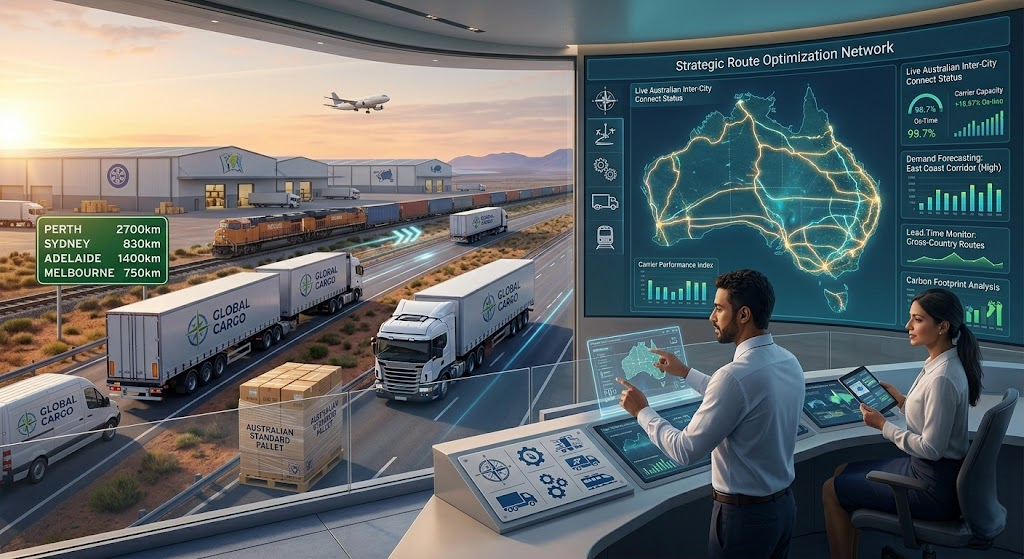
The Australian logistics landscape is currently undergoing a period of rapid evolution. As e-commerce reaches new saturation points, customer expectations for near-instant delivery have fundamentally altered traditional supply chain requirements. Businesses operating in Australia face a uniquely challenging environment where geographical dispersion creates immense pressure on logistics providers. From the bustling urban corridors of the East Coast to the remote industrial sites of Western Australia, the ability to move goods efficiently is the lifeblood of modern commerce. Whether you are scaling an online storefront or managing the transport of heavy industrial machinery, understanding the interplay between various transport modes is no longer optional—it is a competitive necessity.
Why the Road vs. Air Decision Defines Your Bottom Line
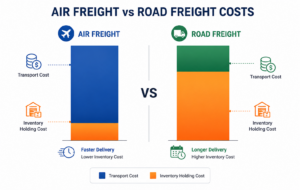
Understanding Total Landed Cost: While air freight carries a higher direct transport fee, it can significantly reduce inventory holding costs compared to slower road freight.
The decision between road and air freight serves as a primary driver of your company’s financial health. Many businesses fail to account for the “inventory holding cost” factor, focusing solely on the invoice provided by their couriers. If choosing air freight allows you to reduce your warehouse stock levels by 48 hours, the capital released from that reduction often outweighs the higher freight rate. Conversely, road freight offers unmatched economic efficiency for bulk movements where time is less critical. This guide will teach you to evaluate these trade-offs, helping you distinguish between situations requiring “just-in-time” delivery and those where cost-optimised, slower transit is the superior business choice.
Understanding the Australian Context: The “Tyranny of Distance”
Geographical Challenges: From the East Coast to the Red Centre
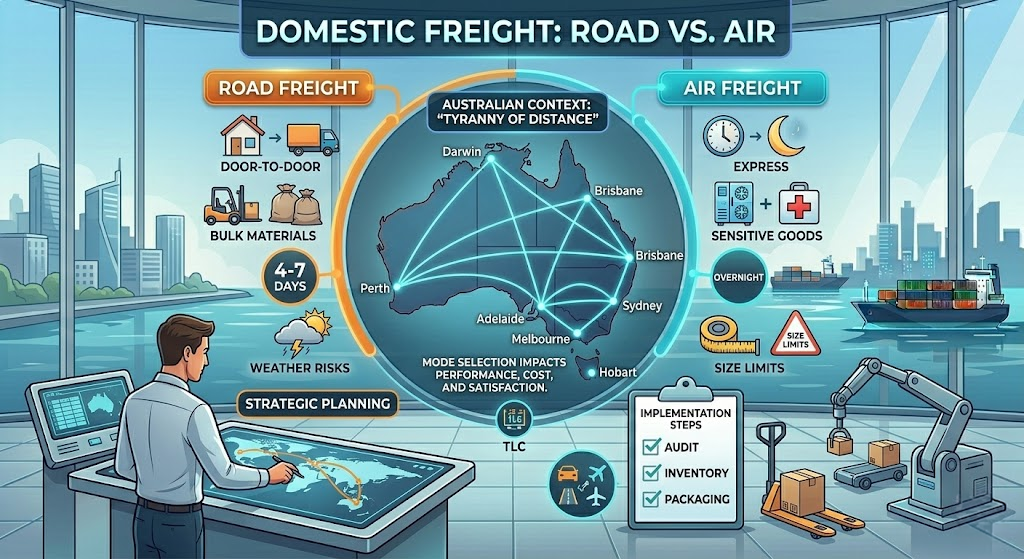
Australia’s vast geography is perhaps the most significant factor in domestic freight management. The “Tyranny of Distance” is not just a historical concept; it is an active operational constraint. Shipping goods from Sydney to Perth involves crossing vast, sparsely populated regions where infrastructure is susceptible to extreme weather, such as heatwaves or flooding. These environmental variables can cause significant road delays, sometimes lasting days. Businesses must account for these risks by diversifying their logistics strategy, ensuring that critical supply chains are not overly reliant on a single road network that may be prone to seasonal disruption.
The Hub-and-Spoke Model: Sydney, Melbourne, and Brisbane as Critical Nodes
Domestic logistics in Australia rely heavily on a hub-and-spoke model, with Sydney, Melbourne, and Brisbane serving as the primary consolidation points. Most interstate freight flows through these cities, where goods are sorted, consolidated, and dispatched toward regional spokes. Understanding this topology is vital for network design. By positioning inventory strategically within these key hubs, businesses can significantly reduce the distance and time required to reach their end customers. If your distribution centre is located in Melbourne, you are naturally advantaged for servicing the southern and eastern markets, whereas a base in Brisbane offers a distinct head start for northern and Queensland-based operations.
The Impact of Infrastructure on Regional and Remote Areas
While major metropolitan centres benefit from highly developed transport infrastructure, regional and remote areas remain vulnerable to service limitations. Road freight is often the only viable option for “last-mile” delivery in these areas, yet it is also the most susceptible to delays caused by infrastructure maintenance or localised weather events. Businesses must recognise that the further a destination is from a major hub, the higher the risk profile of the delivery. Implementing robust tracking systems and maintaining open lines of communication with your logistics partners is essential for managing customer expectations when operating in these geographically isolated zones.
Road Freight: The Backbone of Australian Trade
Versatility and the Advantage of Door-to-Door Accessibility
Road freight remains the workhorse of the Australian economy, providing unparalleled versatility. Its greatest strength lies in door-to-door accessibility; it can reach virtually any site with a road connection, which is rarely true for air-linked infrastructure. For companies shipping to retail storefronts, warehouses, or construction sites, road transport offers a seamless experience that minimises the need for extra handling or transhipment. This accessibility reduces the risk of goods being damaged during the “middle mile” transfer process, as the same vehicle often carries the freight from the depot to the final destination.
Handling Palletised Freight and Full Truckloads (FTL)
For businesses moving high volumes, Full Truckload (FTL) road freight is the gold standard of cost-efficiency. It allows for the transportation of large, heavy, or oddly shaped pallets that would be economically prohibitive to send via air. Road transport systems are designed to accommodate these bulky items, utilising heavy-duty vehicles that maximise load efficiency. When you consolidate your shipments into FTL, you also benefit from reduced handling, as the cargo stays secured within the trailer from the point of origin to the destination, lowering the overall risk of impact or shifting damage.
Cost-Effectiveness for Bulk Shipments and Raw Materials
Road transport is structurally optimised for bulk shipments and raw materials. Because it does not carry the same weight-to-cost penalties as air freight, road is the preferred method for transporting construction materials, industrial components, and bulk consumer goods. If your product is dense and heavy, the cost per kilogram via road is significantly lower than that of any other viable mode. This cost-effectiveness allows businesses to scale their distribution efforts without being constrained by the high price tags associated with rapid, long-distance transit.
Limitations: Transit Times and Environmental Variables
Despite its strengths, road freight has distinct limitations. The most obvious is speed; transit times across the continent can range from four to seven days, depending on the route and the carrier’s schedule. Furthermore, road networks are highly susceptible to “environmental variables”—floods in Northern New South Wales or fire-related road closures can bring supply chains to a complete halt. Businesses must maintain a “Plan B” (such as intermodal rail or urgent air freight) to handle scenarios where road infrastructure becomes impassable, ensuring that business continuity is protected even during extreme events.
Air Freight: When Speed and Security are Non-Negotiable
Time-Definite Freight: Same-Day and Overnight Delivery Windows
Air freight is the primary tool for time-definite logistics. When a critical machine part fails or a customer requires an urgent delivery, air transit provides the necessary speed to maintain operations. In the Australian context, next-day or even same-day delivery between major capital cities like Sydney and Perth is a standard service offering. For eCommerce businesses, providing an “express” shipping option supported by air networks can serve as a key differentiator, boosting customer satisfaction and loyalty in an increasingly fast-paced market.
Protecting High-Value, Perishable, and Medical Supplies
For sensitive goods, air freight offers a level of care that road transport struggles to match. Medical supplies, pharmaceuticals, and high-value electronics often require controlled environments and minimal physical movement. Air transport is faster, meaning the product is exposed to fewer handling points. Fewer handling points mean lower statistical risk of breakage, theft, or spoilage. Furthermore, many air carriers offer temperature-controlled holds, which are essential for transporting perishable goods over long distances across the Australian continent.
Enhanced Security Protocols and Reduced Handling Risks
One of the most under-discussed benefits of air freight is its superior security and reduced handling profile. Air cargo operations are subject to strict regulatory requirements and high-level surveillance, making them an ideal choice for high-value machinery or high-theft-risk consumer goods. Because the freight is subjected to fewer transitions from vehicle to depot to truck, the frequency of “touchpoints” is kept to a minimum. Every time an item is handled, the risk of damage increases; air freight mitigates this by keeping the cargo stationary for the vast majority of its journey.
Limitations: Capacity Constraints and Volumetric Weight Pricing
Air freight is not a panacea; it is hampered by strict capacity constraints and a pricing model that can be punitive for large items. Airlines often rely on the space remaining in the cargo holds of passenger aircraft, limiting the size and weight of individual parcels. Furthermore, air carriers utilise “volumetric weight” pricing, which charges based on the amount of space an item occupies rather than its actual weight. If your products are lightweight but bulky—such as insulation or empty packaging—you will pay a significant premium, often rendering air freight financially unviable for such commodities.
The Financial Reality: Beyond the Base Quote
The “Volumetric vs. Dead Weight” Reality Check
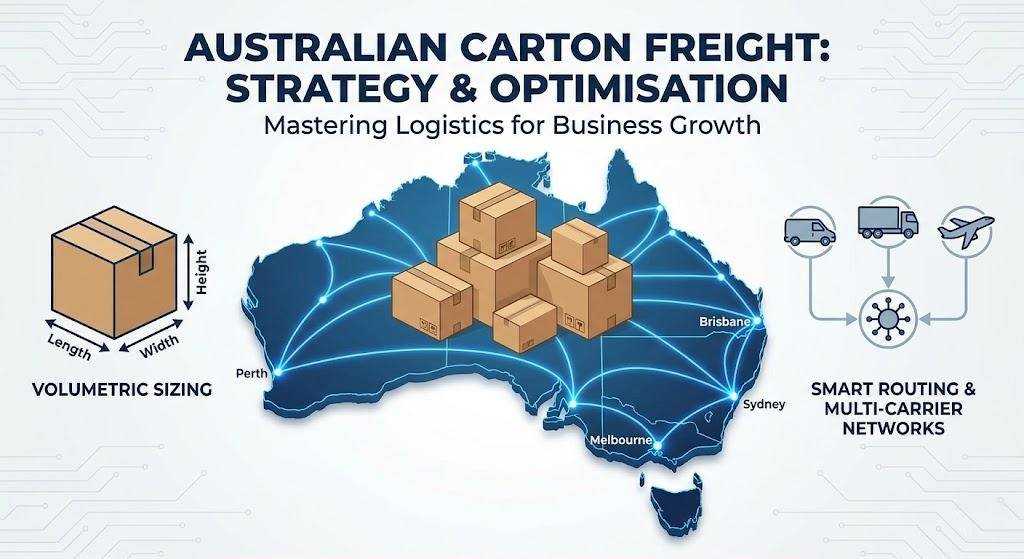
To make informed decisions, you must understand the distinction between dead weight and volumetric weight. Road carriers generally charge based on weight or linear meterage, which favours bulky, lighter cargo. Air carriers, however, utilize a volumetric divisor that converts dimensions into “chargeable weight.” If your parcel is large, the air carrier will charge you as if it were heavy, regardless of its actual mass. Before booking, always calculate your freight’s volumetric weight (Length x Width x Height / 5000 is a common industry divisor) to prevent invoice shock.
Fuel Surcharges, Tolls, and Hidden Surcharges in Domestic Transit
The base freight quote is rarely the final cost. Domestic logistics invoices often include a range of surcharges, including fuel levies, tolls for urban motorway access, and, in the case of regional areas, “out-of-area” surcharges. These costs fluctuate based on global oil prices and local infrastructure changes. When auditing your logistics spend, ensure your accounting systems capture these “hidden” costs, as they can collectively account for 15% to 25% of your total transport expenditure.
Calculating Total Landed Cost: Speed vs. Inventory Holding Costs
Strategic businesses view freight as a component of the Total Landed Cost (TLC). If you choose a slower road freight option, you must carry more safety stock in regional warehouses to cover the transit time. The cost of financing that extra inventory—including storage, climate control, and insurance—is a significant, often ignored, expense. By switching to faster air freight, you may reduce your inventory carrying requirements, thereby freeing up working capital. The goal is to find the “optimum velocity” where the sum of freight costs and inventory holding costs is at its absolute minimum.
Operational Considerations: Optimising for Cargo Characteristics
Packaging Requirements: Protective Crates and Custom Crating
The physical demands of road and air transport differ significantly, requiring different packaging strategies. Road freight involves constant vibration, frequent starts and stops, and potential exposure to humidity. Therefore, palletized goods must be shrink-wrapped and corner-protected to withstand the road environment. Conversely, air freight is more sensitive to pressure changes and rapid loading/unloading. Specialized machinery sent via air often requires custom crating that is G-force resistant. Investing in the correct packaging protects your investment and ensures that you remain within the safety compliance frameworks set by your logistics providers.
Navigating Regulations for Hazardous Goods and Specialised Materials
Both road and air freight operate under strict Australian regulations regarding hazardous materials, but the rules for air are significantly more stringent. If you are shipping lithium batteries, chemicals, or aerosols, you must ensure compliance with the International Air Transport Association (IATA) standards. Road transport, while still heavily regulated, often offers more flexibility for the movement of specialised materials. Always consult your courier’s “dangerous goods” documentation before finalising your shipping method, as failure to comply can lead to rejected shipments, hefty fines, and significant delays.
Freight Warranty and Insurance: Mitigating Risk Across Different Modes
Risk mitigation is the final piece of the operational puzzle. Regardless of the mode, verify the extent of the insurance coverage provided by your courier. Standard liability coverage is often limited to a nominal amount per kilogram, which is frequently insufficient for high-value machinery. It is almost always better to purchase supplemental transit insurance. Remember that the documentation required for an insurance claim differs between road and air; maintain meticulous records of your goods’ condition prior to dispatch, including photographs of the packaging and loading process.
The “Middle Mile” Nuance: Embracing Intermodal Solutions
Why Road and Air Often Work Together (Intermodal Transport)
The most sophisticated supply chains utilise intermodal transport—a hybrid approach where goods are moved via air for the long-haul “first mile” and completed via road for the “last mile.” This strategy exploits the speed of air travel while leveraging the ubiquity of road delivery. By integrating these systems, businesses can ensure that goods arrive at regional hubs quickly, then use local courier networks to complete the final delivery. This is the hallmark of a resilient logistics operation; it avoids the bottleneck of single-mode reliance.
The Role of Interstate Courier Services in the Last-Mile Delivery
Interstate courier services act as the connective tissue for your logistics strategy. Their systems are designed to handle the complexities of the last mile, including urban navigation, gated delivery, and time-sensitive parcel drops. When selecting a courier, evaluate their integration capabilities. Can their tracking systems sync with your eCommerce platform? Do they provide real-time updates that you can share directly with your customer? These operational details are what transform a shipping process into a superior customer experience.
Transitioning from International Terminals to Domestic Networks
For businesses importing goods, the transition from an international terminal to a domestic distribution network is a critical junction. Often, goods arrive at a major airport like Sydney or Melbourne and require immediate onward dispatch. Having a logistics partner that can handle the transition from “International Air Freight” to “Domestic Road Freight” is essential. This seamless transition prevents the cargo from sitting idle in a warehouse, reducing your transit time from the global manufacturer to the final end-user, further optimising your overall supply chain performance.
What’s Next?
Summary of Insights
In this guide, we have explored the essential trade-offs between road and air freight in Australia. We have established that road freight provides the backbone of domestic trade through its accessibility and cost-efficiency for bulk goods, while air freight provides the precision required for high-value, time-sensitive, and perishable cargo. We have highlighted the importance of calculating the Total Landed Cost, emphasising that inventory holding costs are just as high as the shipping rate itself. By understanding the hub-and-spoke geography of the Australian market and the necessity of intermodal integration, you are now equipped to build a more resilient and cost-effective distribution network.
Implementation Checklist
To put these insights into practice, follow these three immediate steps:
- Conduct a Freight Audit: Review your last six months of logistics invoices. Separate your shipments by weight and volume to determine which items were “over-paying” due to volumetric pricing.
- Benchmark Your Inventory Cycle: Analyse the transit times of your most frequently shipped products. Determine the cost of holding that inventory at your current transit speeds and compare it against the cost of upgrading to faster air freight.
- Audit Your Packaging Standards: Review the damage rates for your shipments. If you are experiencing high breakage, revisit your packaging protocols to ensure they meet the specific requirements of the modes you use most frequently.
By implementing these strategies, you move from a reactive logistics posture to a proactive, data-driven approach. Your supply chain will no longer be a drain on resources, but a significant competitive advantage that supports the growth and reliability of your business across the Australian market.
For Australian businesses that need to balance speed, cost, reliability, and delivery expectations, Clique Logistics can help as a practical freight partner. Clique Logistics helps businesses choose the right freight mode by assessing shipment type, urgency, destination, budget, freight visibility requirements, and whether road freight, air freight, or a blended approach is the most suitable option.
This makes Clique a suitable partner for SMEs, retailers, wholesalers, manufacturers, distributors, and eCommerce businesses that want clearer freight guidance, better carrier coordination, and a more structured approach to managing domestic freight across Australia.