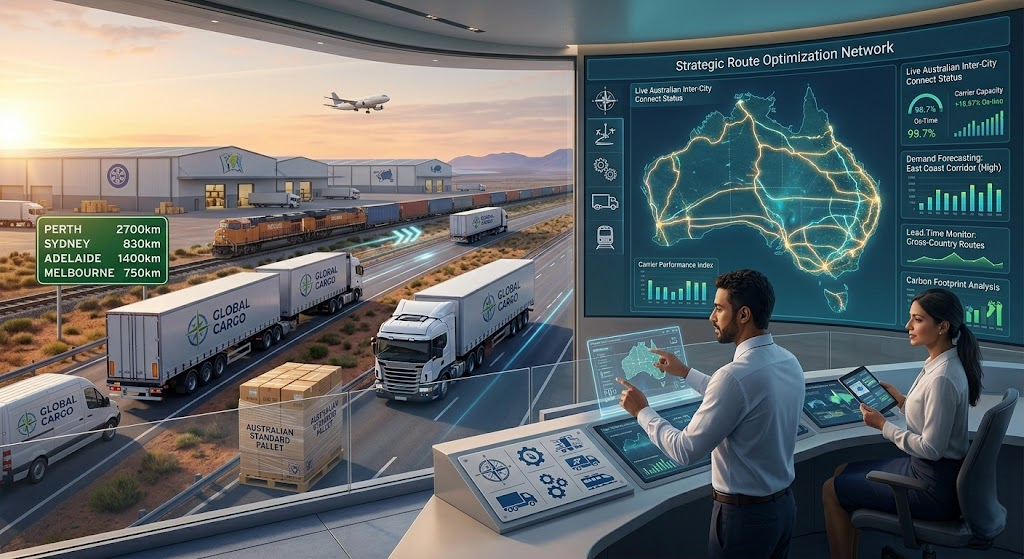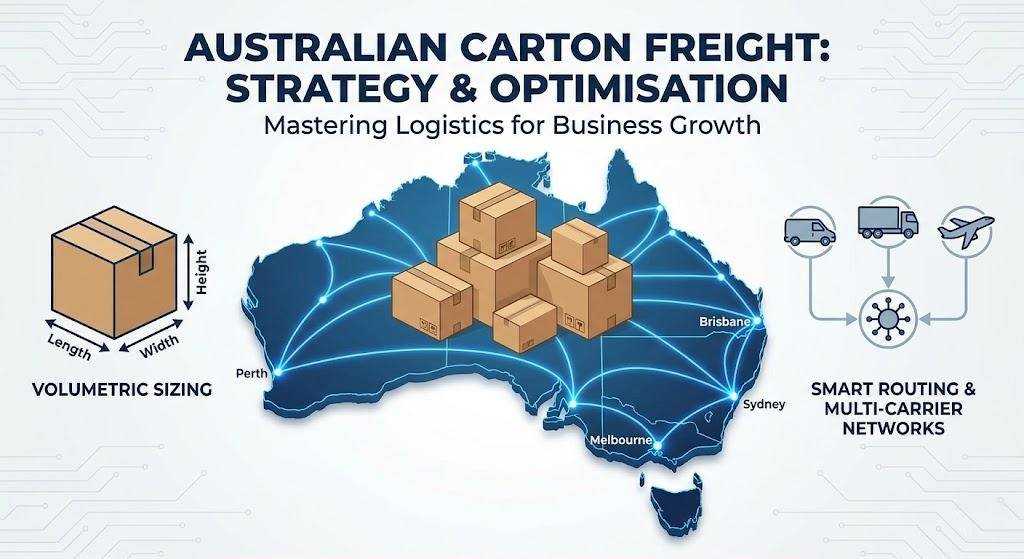
In the modern Australian economy, shipping is no longer a peripheral task reserved for the warehouse floor. It has become the heartbeat of commerce. For businesses operating in Australia, the ability to move goods reliably and cost-effectively serves as a primary competitive advantage. Whether you are managing an eCommerce storefront or a B2B distribution network, the way you handle carton freight determines not only your profit margins but also the strength of your brand’s relationship with your customer.
This guide provides a strategic framework for mastering logistics. You will learn to navigate the complexities of volumetric weight, identify the right carrier partners for your specific geographic profile, and transform your shipping process into a sophisticated tool for business growth. By the time you finish this guide, you will have a clear roadmap to optimise your logistics, reduce waste, and improve your service delivery standards across the country.
Introduction: Moving Beyond Basic Shipping
The Evolution of Logistics in the Australian Market
The Australian logistics landscape has undergone a seismic shift. Once characterised by slow, legacy-driven road freight, the market is now defined by the “eCommerce expectation.” Today, customers demand transparency, speed, and reliability. For many businesses, the transition from local dispatch to national distribution is fraught with complexity, particularly when navigating the unique distances inherent in the Australian continent. Success now requires more than just picking a courier; it requires a sophisticated integration of software, smart data, and a clear understanding of your freight profile.
Shifting from a Cost Centre to a Profit Margin Lever
Forward-thinking Australian businesses have stopped viewing logistics as a necessary evil. Instead, they treat shipping as a profit margin lever. By optimising packaging, negotiating better rates based on volume, and using automated routing, companies can reclaim thousands of dollars annually. Furthermore, a seamless delivery experience is a primary driver of customer loyalty. When logistics is managed effectively, it protects your brand, reduces cart abandonment, and creates a virtuous cycle of repeat purchases.
Defining the “Carton” Space: The Mid-Market Logistics Gap
Satchels vs. Cartons vs. Pallets: Understanding the Difference
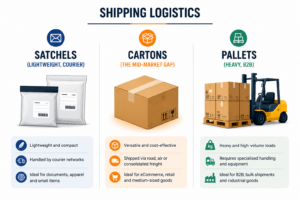
Understanding the three main tiers of freight—and where cartons fit in—is crucial for optimising your shipping costs and carrier selection.
Logistics providers typically categorise goods into three tiers: satchels (lightweight, courier-handled), pallets (heavy, B2B, forklift-loaded), and cartons. The “carton” space—items that are too large for a standard courier satchel but not substantial enough for a full pallet—is where many businesses experience the most friction. This middle ground is where inefficiencies hide. Understanding these boundaries is critical to selecting the right carrier, as billing structures change significantly when shifting from a parcel-based system to a pallet-based one.
The Volumetric Weight Challenge: Why Dimensions Often Trump Weight
In the world of freight, physical weight is rarely the only factor in your invoice. Carriers utilise a “volumetric weight” calculation, which is the physical space your carton occupies in the truck. In Australia, the standard industry formula is often: (Length x Width x Height in cm) / 5000. If your carton takes up a large footprint but is light in weight, you will be billed for the volume, not the scale weight. Many businesses fail to optimise their packaging, leading to “air” being shipped at a premium price.
Identifying Your Freight Profile: Heavy, Bulky, or Fragile?
Before you can optimise your shipping, you must audit your inventory. A business shipping high-density, small-box items will have a completely different logistics profile than a company shipping bulky, fragile electronics. Identifying your specific freight profile allows you to negotiate rates effectively and choose carriers that specialise in your cargo type, rather than accepting generic, one-size-fits-all pricing.
Navigating the Australian Geographic Landscape
Interstate Freight Dynamics: The Sydney-Melbourne-Brisbane Triangle
The Sydney-Melbourne-Brisbane corridor is the engine room of Australian logistics. Here, high volume translates to competitive pricing and rapid turnaround times. Businesses located in Melbourne or Sydney often have the advantage of multiple carrier options and reduced transit times. However, if you rely too heavily on these routes, you may neglect the complexities of your national customer base. Efficient management within this triangle relies on high-velocity scheduling and the integration of robust warehouse systems to ensure rapid dispatch.
The “Long Haul” Logistics: Servicing Perth, Adelaide, and Regional Australia
Shipping to Perth, Darwin, or regional Queensland introduces significant risks. The “long haul” often involves multiple trans-shipments, increasing the risk of damage and extending delivery windows. Businesses must manage customer expectations accordingly. When shipping to these areas, it is vital to account for longer “days to delivery” in your website’s checkout logic to avoid negative customer feedback. Effective strategies include pre-positioning stock in state-based warehouses or using air freight for critical, high-margin goods.
Road Freight vs. Air Freight: Balancing Velocity and Expense
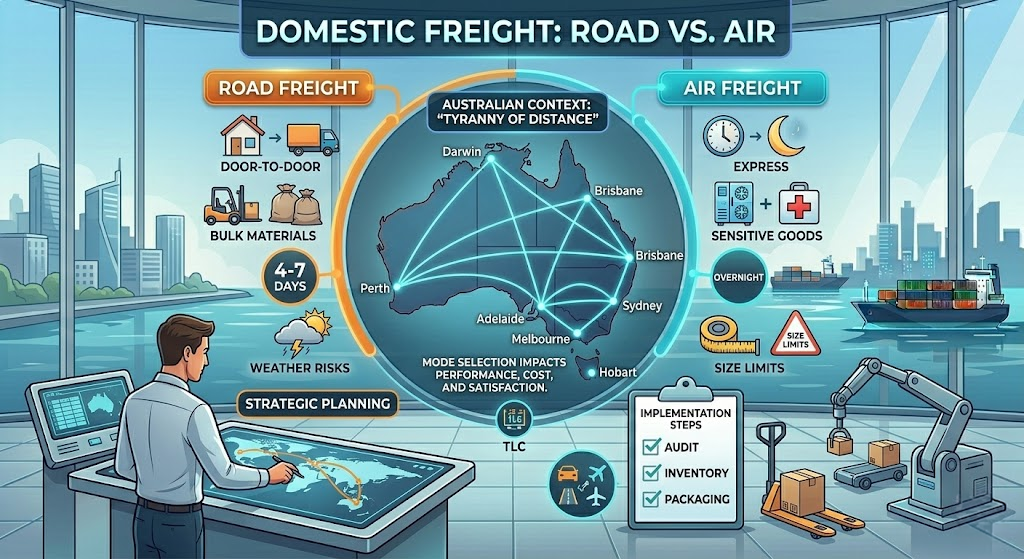
The choice between road and air is a balancing act. While air freight offers speed, it carries a high cost that can evaporate your profit margins. Road freight remains the backbone of the Australian supply chain for most carton shipments. The strategic imperative here is “predictive planning.” By using data to identify which items are time-sensitive and which can afford a two-to-five-day transit, businesses can blend road and air services to optimise for both cost and customer satisfaction.
The Carrier Decision Matrix: Selecting the Right Partners
National Carriers and Tiers: From Toll and StarTrack to Mainfreight
Australia features a robust tier-one carrier market. Toll, StarTrack, and Mainfreight represent the heavy hitters, offering national coverage and complex infrastructure. Choosing these carriers often implies a certain level of security and tracking capabilities. However, they are often less flexible regarding boutique customer service requirements. Larger businesses often split their freight volume between these majors to maintain leverage and ensure that one provider’s network disruption does not halt their entire shipping process.
The Role of Specialised Interstate Courier Services
Specialised couriers fill the gaps that larger national carriers often ignore. Whether it is a regional-specific specialist or a company focused on “white glove” delivery, these providers are essential for high-value or highly specific cargo. They often provide more granular tracking and a higher degree of accountability. For businesses shipping specialised cartons, these couriers are often worth the slight premium in cost for the significant reduction in damage and loss risks.
Multi-Carrier Shipping: Why Relying on a Single Carrier Limits Growth
A common mistake among Australian businesses is relying on a single logistics partner. This creates a “single point of failure.” If your chosen courier experiences a surge in demand, technical issues, or labour strikes, your shipping operations grind to a halt. A multi-carrier approach allows you to route freight based on performance, cost, and availability. By having access to multiple courier systems, you ensure your business remains resilient even during peak seasons like Black Friday or Christmas.
Leveraging Courier Aggregators like Transdirect and Shippit
Courier aggregators have revolutionised logistics for mid-market businesses. Platforms like Transdirect and Shippit provide businesses with access to the rates of major carriers through a single, unified interface. This eliminates the need for separate manual processes for each courier. These platforms also offer automated labelling, tracking integration, and customer notification systems, significantly streamlining the dispatch process and reducing the administrative burden on your staff.
Cost Optimisation Strategies for Carton Freight
Margin Protection: Negotiating Beyond Standard MyPost Business Rates
Many businesses start with standard MyPost Business or entry-level courier rates, but these are rarely optimised for sustained growth. To protect your margins, you must move toward contract pricing. This requires a clear analysis of your shipping volume. When you approach carriers, present your “freight profile”—the number of cartons, typical dimensions, and destination mix. Carriers are far more likely to offer aggressive discounts to high-volume shippers who can demonstrate a consistent, predictable supply of cartons.
SmartRouting: Using Data to Automate Carrier Selection
“SmartRouting” is the use of software to automatically select the best carrier for every individual order based on cost, speed, and weight. By integrating your warehouse system with routing software, you can program rules such as: “If weight is under 2kg and destination is Metro, use Courier A. If the weight is over 5kg and the destination is Regional, use Carrier B.” This automation removes human error and ensures that you are consistently choosing the most cost-effective option for every single package.
Reducing Dimensional Weight: Packaging Optimisation for Better Pricing
If your cartons are too large for your products, you are literally paying to ship air. Packaging optimisation is one of the most effective ways to slash freight costs. By investing in a variety of box sizes—or even bespoke, die-cut packaging—you can reduce your total volumetric weight by 10% to 20%. This small investment in packaging design leads to compounding savings throughout the year, directly improving your bottom line.
The Impact of Surcharges: Navigating Fuel, Residential, and Tail-Lift Fees
Logistics invoices are often cluttered with surcharges that can surprise an unprepared business owner. Residential delivery fees, tail-lift fees (for heavy cartons that cannot be lifted by hand), and fuel levies are standard in the industry. The strategy is to audit your invoices monthly. If you are frequently hit with tail-lift fees, it might be more cost-effective to invest in a small forklift or a loading dock at your warehouse. Understanding these fees is the first step toward avoiding or mitigating them.
Operational Excellence: Technology and Dispatch Integration
The Barcoding Process and Electronic Advance Data (EAD)
Manual entry of delivery addresses is an operational bottleneck. Utilising barcodes and Electronic Advance Data (EAD) ensures that information flows seamlessly from your website to the courier’s network. This reduces misdirected parcels and speeds up the sorting process. When your systems “speak” to your carrier’s system via API, you eliminate the risk of human transcription errors, which are the primary cause of delivery delays in the Australian market.
Implementing AI-Powered Delivery Management and Dispatch Software
The next step in operational maturity is AI-powered delivery management. This software uses historical data to predict delivery times and identify potential bottlenecks before they happen. By providing automated dispatch instructions, these systems allow your team to scale without needing to hire additional staff. They create a frictionless process that transforms a chaotic warehouse floor into a highly coordinated dispatch centre.
Real-Time Tracking and Notifications: Managing Customer Expectations
Modern customers do not want to “wait and see.” They expect real-time visibility from the moment of dispatch. By providing automated email and SMS notifications—triggered by your courier’s tracking updates—you empower your customers. This transparency reduces the volume of “Where is my order?” inquiries, allowing your customer service team to focus on value-added tasks rather than chasing parcels.
Route Optimisation Software for In-House Fleets and Local Deliveries
For businesses running their own delivery vehicles, route optimisation software is non-negotiable. By calculating the most efficient path for your driver, you can reduce fuel consumption, lower maintenance costs, and increase the number of deliveries performed per day. This technology is particularly valuable for businesses in dense urban environments, such as inner-city Melbourne or Sydney, where traffic can make manual route planning highly inefficient.
Logistics as a Customer Service Tool
The Connection Between Shipping Options and Cart Conversion
Shipping costs are a primary reason for shopping cart abandonment. Transparency is key. By offering clear, flat-rate shipping options or free shipping thresholds, you provide the customer with certainty. Integrating your shipping platform into your website’s front-end allows you to show accurate delivery times at checkout. When a customer knows exactly when their order will arrive, they are significantly more likely to complete the transaction.
Last-Mile Delivery: The Final Touchpoint of the Brand Experience
The “last mile” is your final opportunity to make a positive impression. A dented, late, or poorly packaged carton can undo all the hard work that went into product development and marketing. By choosing reliable delivery partners, providing proactive tracking, and ensuring your packaging is durable yet presentable, you turn a logistics event into a brand-building exercise. Remember: for the customer, the courier is often the only human representative of your company they will ever interact with.
What’s Next?
Summary of Insights
We have explored the strategic nuances of the Australian logistics market, covering the critical transition from basic shipping to an optimised freight process. You have learned that the “Carton Gap” is where profit margins are either lost or won, that volumetric weight is a critical metric for cost control, and that technology integration—through aggregators, API-led dispatch, and smart routing—is the foundation of any modern shipping strategy.
Next Steps for Your Business
To move forward, we recommend a three-step implementation plan:
- Conduct a Freight Audit: Review your last three months of logistics invoices. Identify how often you are paying volumetric weight premiums and note which surcharges (fuel, tail-lift, residential) appear most frequently.
- Streamline Your Systems: If you are currently manual-entering labels, look into integrating your warehouse system with a courier aggregator like Shippit or Transdirect. This will provide immediate gains in efficiency and data accuracy.
- Refine Your Packaging: Measure your most frequently shipped items. Are your boxes sized appropriately? Consider ordering custom-sized cartons or standardised packaging that minimises volumetric space to lower your per-unit costs.
Logistics is a dynamic field, but by shifting your mindset from cost-containment to strategic management, you position your business for scalable growth. The goal is to build a logistics system that is so reliable and efficient that it becomes a hidden engine driving your customer satisfaction and, ultimately, your competitive success in the Australian market. Success in this area is not achieved in a day, but through consistent, data-driven improvements that ultimately pay dividends in customer loyalty and bottom-line performance. Start by picking one area of your freight process to optimise this month, and measure the results—you will likely find that small, calculated changes lead to significant operational maturity.
For Australian businesses that regularly ship cartons across the country, Clique Logistics can help as a practical freight management partner. Clique Logistics supports businesses with carton freight coordination by helping manage carrier selection, shipment visibility, route planning, freight communication, and domestic delivery requirements across local, regional, and interstate networks.
This makes Clique a suitable partner for SMEs, retailers, wholesalers, manufacturers, distributors, and eCommerce businesses that want a more structured approach to managing carton freight, reducing unnecessary freight complexity, and improving the reliability of deliveries across Australia.