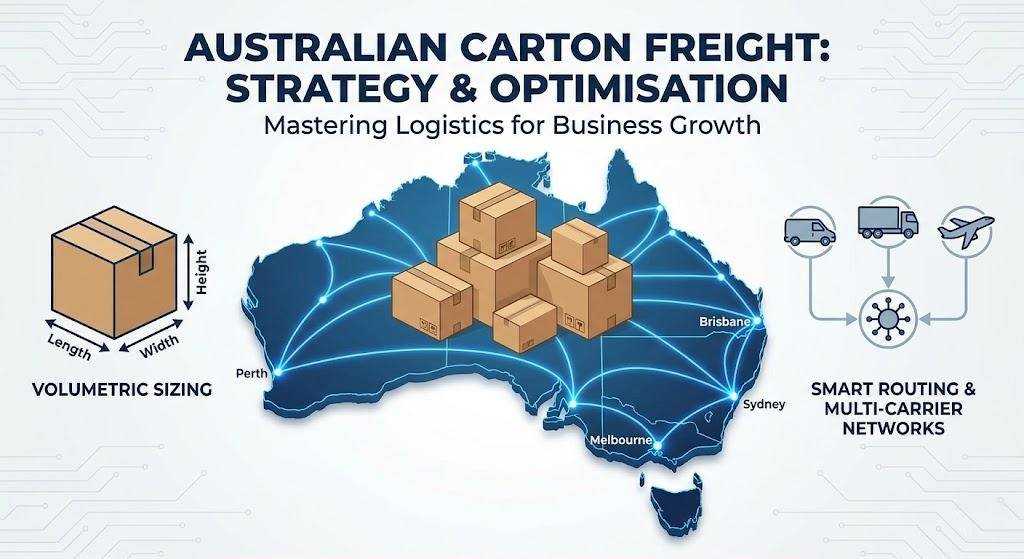
Interstate freight is often viewed by Australian business owners as a transactional headache—a necessary evil required to move goods from point A to point B. However, shifting your perspective on logistics can transform this function from a simple cost centre into a powerful competitive advantage. By treating your supply chain as a strategic asset, you can enhance customer loyalty, improve operational efficiency, and significantly boost your bottom line.
In this guide, you will learn how to navigate the complex Australian logistics network. Whether you are managing small parcels or large-scale pallet freight, you will gain the tools required to optimise your shipping profile, select the right partners, and avoid the common pitfalls that drain profitability. By the end of this article, you will have a clear roadmap for scaling your business operations across the vast distances that define our national landscape.
Why Interstate Freight is Critical for Australian Business Growth
For any Australian business operating across state lines, logistics serves as the heartbeat of the organisation. Growth depends on your ability to deliver products reliably, regardless of whether your customer is located in a high-density urban centre or a remote regional location.
Navigating the Vast Australian Landscape: From Perth to Sydney
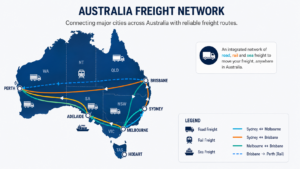
Understanding Australia’s unique geography is crucial: dense networks connect the East Coast, while cross-country freight to Perth requires accounting for extended lead times.
The geography of Australia presents a unique set of challenges. Transit between major capital cities like Sydney, Melbourne, and Brisbane benefits from highly developed road and rail networks. In contrast, moving freight to Perth or regional areas requires a sophisticated understanding of cross-country lead times. Businesses that underestimate these geographic realities often suffer from inventory stockouts or exorbitant “rush” shipping fees. Mastering these lanes is the first step toward operational maturity.
The Role of Logistics in Modern Supply Chain Management
Modern supply chain management is no longer just about trucks and planes; it is about data integration. By linking your inventory systems directly with your logistics partners, you remove human error and provide customers with the transparency they expect. When your systems communicate seamlessly, you can forecast demand more accurately, allowing for better stock positioning across your national network.
Turning Freight from a Logistics Headache into a Competitive Advantage
When your freight process is optimised, it becomes invisible to the customer—which is exactly how you want it. Reliable delivery becomes a marketing tool. If you can consistently beat expected delivery windows, you build trust. In a crowded e-commerce market, this reputation for reliability is a significant differentiator that justifies price premiums and encourages repeat business.
Mapping Your Freight Requirements: Identifying Your Shipping Profile
Before you sign a contract with a carrier, you must diagnose your specific shipping profile. Are you a high-volume parcel shipper or a pallet-based enterprise? Understanding your profile prevents overspending on services you don’t need.
Speed vs. Cost: Choosing Between Same-Day, Next-Day, and Standard Road Freight
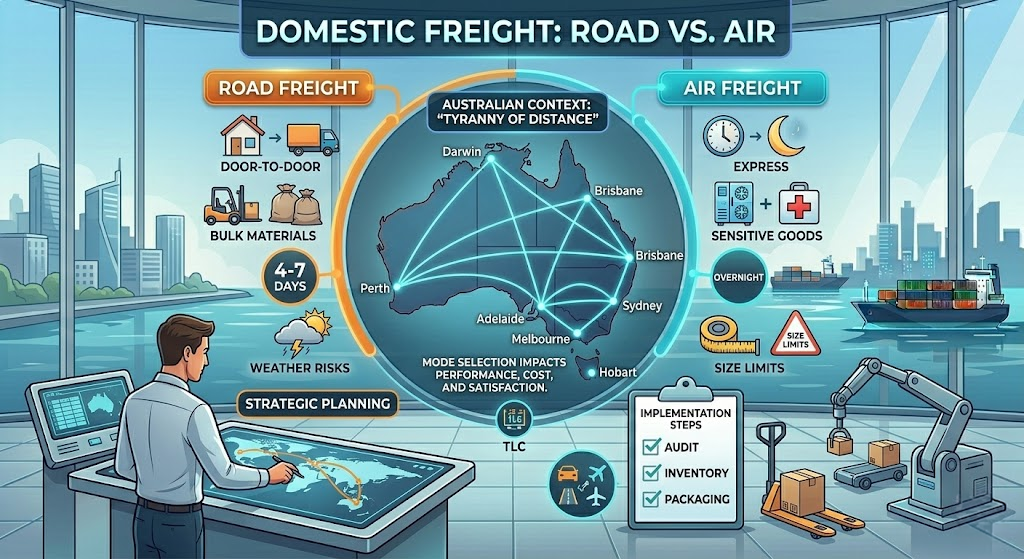
Speed is expensive. You must weigh the “cost of urgency” against the “value of the sale.” If your business model relies on high-margin, time-sensitive goods, next-day services are worth the investment. However, for bulk supplies or long-lead items, utilising standard road freight across the Sydney-Melbourne-Brisbane triangle offers the best balance of cost and efficiency. Never pay for express air freight if your customer is willing to wait four days for a standard road delivery.
Volume and Weight: When to Move from Parcels to Interstate Pallet Freight
Once your volume increases, parcel-based shipping often becomes inefficient. A shipment of 20 small boxes is usually more expensive than one wrapped pallet. If you are regularly shipping more than five units to a single location, it is time to transition to pallet freight. Pallets provide better stability, lower handling costs, and usually benefit from volume-based pricing structures that parcels cannot access.
Specialised Cargo: Handling Temperature-Controlled Goods, Plants, and Fragile Items
Not all freight is equal. If you move perishables or high-value items, you need specialised carriers. Temperature-controlled shipping requires strict adherence to cold-chain regulations. For fragile items, prioritise partners who offer “white-glove” services, even if it adds to your cost. The price of one broken, high-value item often exceeds the savings gained from choosing a cheaper, low-care courier.
Choosing the Right Logistics Partner for Your Network Reach
The carrier you choose acts as a representative of your brand. Selecting a partner solely based on price is a common mistake that leads to poor delivery outcomes.
Evaluating Carrier Coverage: Capital Cities vs. Regional and Rural Deliveries
A major national carrier may excel in Melbourne and Sydney but struggle in regional Western Australia. Evaluate your shipping distribution. If a large percentage of your deliveries occur in regional or rural zones, you may need a carrier with a specialised regional depot network rather than a generic national provider. Always request a coverage map from potential partners to see where their “weak spots” lie.
The Tech Advantage: Real-Time Tracking and Integrated Dashboards
In the modern era, data is currency. You need a partner that offers an API integration into your existing e-commerce or warehouse management software. Real-time tracking isn’t just for you; it is for your customers. When your dashboard triggers automatic updates on delivery status, you reduce the volume of “where is my order” inquiries, freeing up your team to focus on high-value tasks rather than customer support.
Assessing Reliability: Delivery Success Rates and Customer Service Quality
Reliability is the ultimate indicator of a good partner. Request historical data on their delivery success rates. A partner with a 98% on-time rate is worth a 5% premium over a partner who hits 90%. Furthermore, test their customer service responsiveness before you sign a contract. If they don’t answer your calls during the onboarding phase, they certainly won’t answer them when a shipment goes missing.
The Financials: Mastering Cost Management and Avoiding Surprises
Logistics costs are often loaded with variables. To protect your bottom line, you must decode the invoice before it hits your desk.
Understanding the Variable Factors: Fuel Surcharges and Handling Fees
Fuel surcharges are a reality of the Australian transport industry. However, they should be predictable. Ensure your contract specifies a transparent fuel surcharge formula tied to public indices. Be equally wary of “handling fees” for off-standard dimensions. If your item is oddly shaped, it may be hit with manual handling surcharges that can double the base rate if not pre-negotiated.
Bulk Delivery and Volume Discounts: Strategies for Budget Optimisation
Always negotiate based on volume tiers. If you can bundle your shipments into fewer, larger pickups, you improve your leverage for discounts. Consider consolidation: if you ship to Brisbane multiple times a week, investigate whether holding stock and shipping once or twice a week at a higher volume provides a better price point than daily low-volume dispatch.
Decoding Delivery Fees: Avoiding Hidden Costs at the Checkout
Hidden fees are the primary cause of margin erosion. Common traps include re-delivery fees, after-hours delivery, and waiting time charges at the receiving site. Review every quote for “accessorial charges.” If your customer does not have a loading dock, ensure the “tail-lift” fee is captured at the time of order, not invoiced as a surprise later.
Operational Excellence: Preparing Your Goods for Long-Haul Transit
Your responsibility for the goods does not end at your loading dock. Proper preparation is the primary defence against damage.
Australian Standard Pallets: Choosing Between Plastic, Wooden, CHEP, and Loscam
Understand the pallet ecosystem. Most Australian carriers prefer industry-standard pallets like CHEP or Loscam. Using wooden pallets is common, but plastic pallets may be required for specific hygiene standards. Ensure your choice of pallet is compatible with your carrier’s handling equipment to avoid unnecessary transfer fees or refusal of transit.
The Importance of Proper Weight Distribution and Secure Wrapping
Physics is unforgiving in transit. Heavy items must be placed at the base of the pallet, with lighter items layered on top. Use industrial-grade stretch wrap to secure the load. A pallet that is not properly wrapped will shift during long-haul transit, increasing the risk of breakage. Always use corner boards to prevent strapping from damaging your product packaging.
Reducing Damage Rates: Packing Techniques for High-Value Business Shipments
For high-value items, double-boxing or adding protective foam inserts is standard practice. Consider the “drop test”—if your package falls from a height of one meter, will it survive? If the answer is no, your packaging is insufficient. Investing in high-quality packaging materials is significantly cheaper than processing insurance claims or managing customer returns for damaged items.
Solving the “Last Mile” Bottleneck: Recipient Readiness and Site Access
The “last mile” is the most expensive and volatile part of the logistics chain. Often, success or failure hinges on a simple logistical detail.
Site Requirements: Confirming Forklift Availability and Loading Dock Access
Never assume a customer can unload your goods. Before dispatching, confirm: Does the recipient have a loading dock? Do they have a forklift? If the answer is no, you must mandate a “tail-lift” truck at the time of booking. A tail-lift truck will lower the goods to the ground, preventing the driver from being forced to return the goods to the depot, which incurs a heavy re-delivery fee.
Tail-Lift Services and Pallet Jacks: Solutions for Limited-Access Suburbs
In dense suburban environments where large trucks cannot manoeuvre, you may need a smaller delivery vehicle or an electric pallet jack. Discuss the delivery environment with your carrier. Providing clear notes about restricted access or steep driveways ensures the driver is prepared, preventing delivery failures that can stall your sales process.
Managing the Recipient Experience: Proactive Communication and Delivery Windows
The recipient is the final link in your service chain. Proactive communication is key. Send an automated notification to your customer once the goods are on the truck. Providing a clear delivery window reduces the frustration caused by long wait times and minimises the chances of the customer being unavailable when the driver arrives.
Risk Management: Protecting Your Bottom Line
Logistics is an exercise in risk management. You must balance the cost of protection against the potential cost of loss.
Navigating Insurance Options: Transit Cover vs. Full Comprehensive Insurance
Standard carrier liability is often limited to a weight-based amount, which rarely covers the replacement value of high-end commercial goods. Always review your insurance options. Transit cover is often more cost-effective than standard insurance, but it requires that you strictly follow the carrier’s packing guidelines. If you fail to follow the packing rules, the insurance is voided. Read the fine print before shipping high-value assets.
Implementing Systems for Real-Time Visibility and Accountability
Accountability requires visibility. Use tracking systems that provide status updates at every scan point. If a shipment sits in a depot for more than 24 hours, your system should flag it for intervention. Having an internal “freight coordinator” who monitors these alerts is a small cost compared to the loss of a major client due to a “missing” pallet that was simply sitting in the wrong corner of a warehouse.
Managing Customer Expectations for Interstate Shipping Times
Be honest with your customers. If you are shipping from Melbourne to Perth, manage expectations by adding a buffer for potential weather or logistics delays. It is always better to over-deliver on a conservative estimate than to under-deliver on a promise that ignores the reality of long-distance transit.
Regulatory Compliance and Cross-Border Considerations
Operating across Australia means adhering to a range of regulations, including the “Chain of Responsibility” (CoR) laws. Even if you outsource the trucking, you are still legally responsible for ensuring that goods are loaded safely and that drivers are not pressured to speed or breach fatigue management laws.
Compliance extends to biosecurity as well. If you are shipping plants or certain food products into states like Western Australia or Tasmania, be aware of strict quarantine regulations. Failure to comply can result in the seizure and destruction of your goods. Always check the Department of Agriculture, Fisheries and Forestry guidelines before sending restricted items interstate.
What’s Next?
By now, you have a comprehensive understanding of the mechanics behind interstate freight in Australia. You have learned that efficiency begins with a clearly defined shipping profile, is maintained through smart technology integration, and is protected by rigorous adherence to packing and site-access standards.
Your Action Plan:
- Audit Your Current Logistics Costs: Break down your last three months of invoices. Categorise costs into base shipping, fuel surcharges, and “unexpected” fees like re-deliveries or manual handling charges.
- Define Your Shipping Profile: Determine the ratio of parcels to pallets you move monthly. Use this to approach carriers for tiered volume discounts.
- Implement a Tracking Dashboard: Evaluate whether your current carrier offers an API. If not, consider a “freight-tech” aggregator that integrates with your e-commerce store to provide central visibility.
- Update Your “Last Mile” Checklist: Add a mandatory requirement to your checkout or internal order process that confirms the recipient’s site access—specifically asking about forklift and loading dock availability.
- Review Insurance Coverage: Check if your existing policy covers your goods while in transit, or if you need to add specific marine or transit insurance to your business portfolio.
Freight is the physical extension of your business strategy. By applying these tips, you will reduce your operational overhead, minimise damage-related losses, and create a customer experience that supports your business’s long-term growth. Logistics is no longer a headache; it is your competitive advantage. Start implementing these changes today to build a more resilient and profitable supply chain.
For Australian businesses that need better control over interstate freight, Clique Logistics can help as a practical freight broker and freight management partner. Clique Logistics helps businesses coordinate interstate freight across multiple carriers, routes, freight types, and delivery requirements, including pallet freight, carton freight, road freight, air freight, and domestic business freight.
This makes Clique a suitable partner for SMEs, retailers, wholesalers, manufacturers, distributors, and eCommerce businesses that want clearer freight visibility, stronger carrier coordination, and a more organised approach to moving goods across Australia.